Hobonichi Pencil Board: A6 & A5 Sizes, Uses & Fit
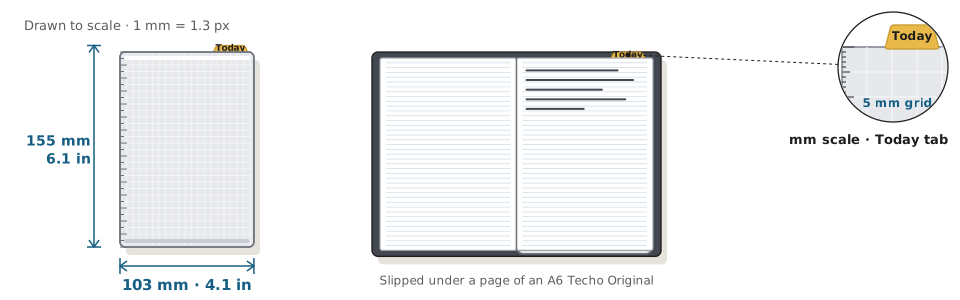
The Hobonichi Pencil Board is a thin sheet of synthetic paper that you slip under the page you're writing on in a Hobonichi Techo. It gives a firm, smooth surface and keeps pen pressure from marking the thin pages below. The A6 board is 155 × 103 mm and 0.4 mm thick, with a millimetre scale and a Today tab.
On this page
Product facts
- Product
- Hobonichi Pencil Board for A6 size (Ice Gray × Yellow; also A5 and Weeks sizes)
- Brand
- Hobonichi
- Brand origin
- Japan
- Made in
- Japan*
- Material
- Synthetic paper (Yupo, polypropylene)
- Price range
- $$$5–20 per item
Notes on these facts
- Made by Hobonichi Co., Ltd. (Tokyo). Made in Japan: Luiban lists the Gray × Yellow A6 board as made in Japan, and Minimaru gives Japan as the country of manufacture for an artist-designed A6 board. Hobonichi's Japanese and English store pages don't state the country. Source. Price: example listing.
- Price bands are typical US retail, checked October 2026. Conversions to US dollars are approximate, at October 2026 rates (US$1 = ¥158 = ₩1,330 = NT$32.5 = CN¥6.7 = SEK 9.9 = DKK 6.7 = ₺49.6 = C$1.41 = A$1.43; €1 = US$1.12; £1 = US$1.32; CHF 1 = US$1.21).
Key takeaways
- The A6 board measures 155 × 103 × 0.4 mm and weighs about 6 g, per Hobonichi's store.
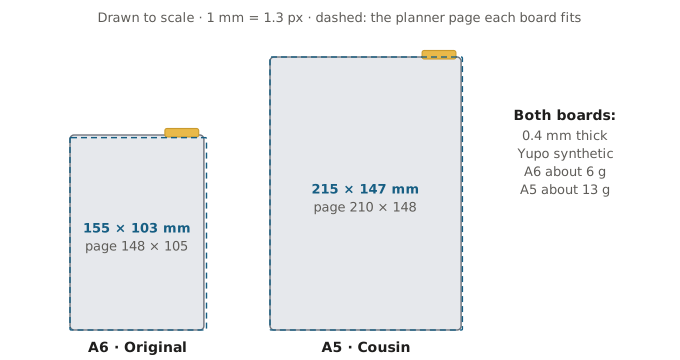
- The A5 (Cousin) board is 215 × 147 × 0.4 mm and about 13 g; the Weeks board is 187 × 88 mm and about 7 g.
- It's made of Yupo synthetic paper, with a 5 mm grid on the face and a 1 mm scale along the long edge.
- Hobonichi's Japanese store lists the boards at ¥380 (about US$2.40) to ¥600 (about US$3.80) including tax, depending on size.
- Luiban and Minimaru list it as made in Japan.
What is the Hobonichi Pencil Board?
It’s a thin, stiff sheet you slip under the page you’re writing on, to give the pen a firm surface. In Japan this kind of board is called a shitajiki; Hobonichi sells its own in sizes cut for its planners.
Hobonichi says many people use it every year because it keeps ballpoints from slipping. It comes in two plain colorways, Ice Gray × Yellow and Navy × Pink, plus artist designs.
Hobonichi Pencil Board specs
| Spec | A6 (Original, A6 Planner) | A5 (Cousin) | Weeks |
|---|---|---|---|
| Size | 155 × 103 mm (6.1 × 4.1 in) | 215 × 147 mm (8.5 × 5.8 in) | 187 × 88 mm (7.4 × 3.5 in) |
| Thickness | 0.4 mm | 0.4 mm | 0.4 mm |
| Weight | About 6 g | About 13 g | About 7 g |
| Material | Synthetic paper (Yupo) | Synthetic paper (Yupo) | Synthetic paper (Yupo) |
| Features | 5 mm grid, 1 mm scale, TODAY tab | Same | Same |
| Price band | $$ ($5–20 per board) | $$ | $$ |
| Made in | Japan (per retailers) | Japan (per retailers) | Japan (per retailers) |
Sizes, weights and material come from Hobonichi’s Japanese store page (ほぼ日の下敷き), which notes small differences between pieces. Little Craft Place gives the same 7.4 × 3.5 in for the Weeks board.
What does it actually do?
It firms up the page and stops your writing from denting the pages underneath. Hobonichi’s planners use thin Tomoe River paper, and the store says the board helps when pen pressure leaves marks, or when you’ve filled the cover’s inner pockets with thick items.
Hobonichi also says it keeps ballpoints from slipping. We haven’t tested either claim yet.
How do you use it?
Open the planner to today’s page and slide the board under it, Today tab up. The board stays in the book as you write, then marks the page when you close it.
- Put the board behind the page you’re about to write on, not behind the whole book.
- Let the tab stick out above the top edge, so it works as a bookmark.
- Move it forward a page each day; at 0.4 mm and about 6 g for the A6, it adds little bulk.
If you use a cover with a pen holder or pockets, the board is the part that keeps a bulky pocket from pushing through as bumps under your pen. Hobonichi recommends it for exactly that case.
Which size do you need?
Match the board to your planner: A6 for the Original and A6 planners, A5 for the Cousin, and the Weeks board for the Weeks.
| Planner | Page size | Board |
|---|---|---|
| Hobonichi Techo Original | 148 × 105 mm | A6 |
| Hobonichi Techo Cousin | 210 × 148 mm | A5 |
| Hobonichi Weeks | Slim, tall | Weeks |
Hobonichi says the A6 and A5 boards also suit its HON, day-free, Planner and 5-Year Techo books in those sizes. Because the A6 board is 103 mm wide, it also fits under the pages of most other A6 (105 × 148 mm) notebooks, with the tab showing at the top.
Is it also a ruler and bookmark?
Yes: Hobonichi says the long edge carries a scale in 1 mm steps and the TODAY tab in the corner marks today’s page. The face has a 5 mm grid, handy for lining up boxes or a quick table.
For a metal option that clips onto the page instead, see the Midori Clip Ruler, which has a 10 cm scale and a stencil.
How much does it cost?
Hobonichi’s Japanese store lists the plain boards at ¥380 (about US$2.40) to ¥600 (about US$3.80) including tax, depending on size. In the US, shops that import it usually charge in our $$ band ($5–20 per board).
Prices vary by size and design, so check the exact board you want.
Where is the Hobonichi Pencil Board made?
Retailers list it as made in Japan. Luiban says so for the Gray × Yellow A6, and Minimaru gives Japan as the country of manufacture for an artist-designed A6 board.
Hobonichi is based in Tokyo. We didn’t find the country on its Japanese or English store pages.
Frequently asked questions
What is a Hobonichi Pencil Board for?
It goes under the page you're writing on. Hobonichi says it suits people bothered by pen marks pressed into the thin Tomoe River pages, and that it stops ballpoints from slipping.
What size is the Hobonichi Pencil Board?
Hobonichi lists the A6 board at 155 × 103 mm (6.1 × 4.1 in) and 0.4 mm thick, the A5 Cousin board at 215 × 147 mm, and the Weeks board at 187 × 88 mm (7.4 × 3.5 in).
Does the A6 pencil board fit the Hobonichi Techo Original?
Yes. It's made for the A6 Original's 148 × 105 mm pages, and Hobonichi says the A6 board also suits its A6 HON, day-free, Planner and 5-Year Techo books. At 155 mm tall, the TODAY tab peeks out above the page.
What is the Hobonichi Pencil Board made of?
Hobonichi lists synthetic paper (合成紙, Yupo). Luiban describes Yupo as a water-resistant polypropylene sheet that wipes clean.
Can I use the pencil board as a bookmark or ruler?
Yes. Hobonichi says the TODAY tab in the corner marks today's page, and the long edge has a scale in 1 mm steps; the face has a 5 mm grid.
How much does a Hobonichi Pencil Board cost?
Hobonichi's Japanese store lists the Ice Gray × Yellow and Navy × Pink boards at ¥380 (about US$2.40) to ¥600 (about US$3.80) including tax. US shops usually charge in our $$ band, $5–20.
Where is the Hobonichi Pencil Board made?
Retailers including Luiban and Minimaru list it as made in Japan. Hobonichi is based in Tokyo and doesn't state the country on its store page.
Sources
- ほぼ日の下敷き アイスグレー×イエロー/ネイビー×ピンク - ほぼ日手帳 2027 (Hobonichi Japanese store: A6 155 × 103 × 0.4 mm, 6 g; A5 215 × 147 mm, 13 g; Weeks 187 × 88 mm, 7 g; Yupo; ¥380–¥600)
- Hobonichi Store (English): Hobonichi Pencil Board, Ice Gray × Yellow / Navy × Pink
- The Journal Shop: Hobonichi Pencil Board, Ice Gray × Yellow
- Yoseka Stationery: Hobonichi Pencil Board, Ice Gray × Yellow
- Little Craft Place: Hobonichi Pencil Board for Weeks (7.4 × 3.5 in)
- Luiban: Hobonichi Pencil Board Gray × Yellow A6 (Yupo polypropylene; made in Japan)
- Minimaru: Hobonichi Pencil Board for A6 (country of manufacture Japan)
- The Journal Shop: Hobonichi Pencil Board, Hiroko Kubota design