Best Vintage Fountain Pens to Buy (2027): 9 Classics
The Parker 51 (1941–1972) is the best vintage fountain pen to buy: tough, common and easy to service. The Parker Vacumatic and Duofold, Sheaffer Balance and Snorkel, Esterbrook J, Pelikan 400, Waterman 52 and Eversharp Skyline complete our nine. Buy restored pens with a filling-system guarantee, from a restorer or at a pen show.
On this page
Products compared
| Product | Brand origin | Made in | Price range |
|---|---|---|---|
| Parker 51 fountain pen (1941–1972)Parker | United States | United States* | Price range: $$$$ |
| Parker Vacumatic fountain penParker | United States | United States* | Price range: $$$$ |
| Parker Duofold fountain penParker | United States | United States* | Price range: $$$$ |
| Sheaffer Balance fountain penSheaffer | United States | United States* | Price range: $$$$ |
| Sheaffer Snorkel fountain penSheaffer | United States | United States* | Price range: $$$$ |
| Esterbrook J fountain penEsterbrook | United States | United States* | Price range: $$$$ |
| Pelikan 400 and 400NN fountain penPelikan | Germany | Germany* | Price range: $$$$ |
| Waterman's Ideal No. 52 fountain penWaterman | United States | United States* | Price range: $$$$ |
| Eversharp Skyline fountain penWahl-Eversharp | United States | United States* | Price range: $$$$ |
Notes on these facts
- Parker 51 fountain pen (1941–1972): Made by The Parker Pen Company, Janesville, Wisconsin. Made in United States: The original 51 was made at Parker's Janesville, Wisconsin, factory (Richard Binder). It was also made outside the US: vintagepens.com lists English-made 51s, and Binder says unofficial production continued in Argentina into the 1980s. Check the imprint. Source. Price: example listing. Released: Richard Binder: introduced in 1941 (test-marketed from 1939), discontinued in 1972. Vacumatic filler 1941–1948, Aero-metric 1948–1969, squeeze filler Mark III 1969–1972. Parker reissued a reimagined cartridge/converter 51 in 2021.
- Parker Vacumatic fountain pen: Made by The Parker Pen Company, Janesville, Wisconsin. Made in United States: Made by Parker USA until about 1948, per Richard Binder, and in Canada and possibly other countries at least into 1953. Check the imprint. Source. Price: example listing. Released: Test-marketed as the Golden Arrow from August 1932, renamed Vacuum Filler and then, in July 1933, Vacumatic (Richard Binder, citing Parkergrams).
- Parker Duofold fountain pen: Made by The Parker Pen Company, Janesville, Wisconsin. Made in United States: US production per Richard Binder's Duofold profile; vintagepens.com also lists Canadian-made Duofolds. Check the imprint. Source. Price: example listing. Released: Prototypes sold in mid-1921 and the first ad ran on November 5, 1921 (Richard Binder). The Striped Duofold lasted into 1948.
- Sheaffer Balance fountain pen: Made by W. A. Sheaffer Pen Company, Fort Madison, Iowa. Made in United States: Sheaffer was based in Fort Madison, Iowa; Richard Binder's Balance profile describes US production but doesn't name the factory for this model. Source. Price: example listing. Released: Introduced in 1929 and discontinued in 1942 in favor of the Triumph models (Richard Binder). Sheaffer's 1990s Balance II is a modern pen.
- Sheaffer Snorkel fountain pen: Made by W. A. Sheaffer Pen Company, Fort Madison, Iowa. Made in United States: Snorkel imprints read Fort Madison, Iowa, U.S.A., per Richard Binder's profile. Source. Price: example listing. Released: 1952–1959; only the PFM, introduced in 1959, continued the system after that (Richard Binder).
- Esterbrook J fountain pen: Made by R. Esterbrook & Company, Camden, New Jersey. Made in United States: Esterbrook was based in Camden, New Jersey (Richard Binder). Binder's profile doesn't name a final production year. Source. Price: example listing. Released: Richard Binder: the streamlined model appeared in about 1943 and took Esterbrook's lever filler within a year or so.
- Pelikan 400 and 400NN fountain pen: Made by Günther Wagner Pelikan-Werke, Hannover. Made in Germany: German production by Pelikan, Hannover; pelikan-collectibles.com also lists export models and a 400NN variant made by Merz & Krell. Check the imprint. Source. Price: example listing. Released: Pelikan-collectibles.com: the 400 was presented on May 25, 1950 and made until 1956; the 400N was made in 1956 and the 400NN from 1956 to 1965. A forum thread notes one reference gives 1957 for the 400N-to-400NN change.
- Waterman's Ideal No. 52 fountain pen: Made by L. E. Waterman Company, New York. Made in United States: US production per Richard Binder; vintagepens.com also lists a late Canadian-made 52 from about 1930. Waterman is a French brand today, but the 52 was made by the American company. Source. Price: example listing. Released: Waterman's first lever fillers came about 1915 as the Ideal No. 12PSF; renumbered No. 52 about two years later, and still made in hard rubber into the 1930s (Richard Binder).
- Eversharp Skyline fountain pen: Made by The Wahl Company (Eversharp). Made in United States: American production per Richard Binder's Skyline profile, which doesn't name the factory. Source. Price: example listing. Released: Introduced in summer 1940 and discontinued in about 1948 in favor of the Symphony (Richard Binder). Designed by Henry Dreyfuss.
- Price bands are typical US retail, checked October 2026. Conversions to US dollars are approximate, at October 2026 rates (US$1 = ¥158 = ₩1,330 = NT$32.5 = CN¥6.7 = SEK 9.9 = DKK 6.7 = ₺49.6 = C$1.41 = A$1.43 = CZK 21.7; €1 = US$1.12; £1 = US$1.32; CHF 1 = US$1.21).
Key takeaways
- Parker made the 51 for 31 years, from 1941 to 1972; collector sources put sales at about 20 million pens.
- Esterbrook's screw-in Renew-Point nibs came in 33 styles, per Richard Binder, so owners can swap nib units themselves.
- Pelikan-collectibles.com lists the 1950–1956 Pelikan 400 at 126 mm long and 15.3 g, with a 2.0 ml piston-filled reservoir.
- Most restored examples of our nine picks listed at two US restorers on October 21, 2026 were priced between US$150 and US$800; rare variants ran past US$1,000.
- David Nishimura's FAQ puts a basic repair of an undamaged pen at about US$25–60, depending on the filling mechanism.
What are the best vintage fountain pens to buy?
The Parker 51 is the best vintage fountain pen to buy, and eight more classics made before 1970 are still easy to find, restore and use. We picked them from restorer catalogs and pen historians, chiefly Richard Binder and David Nishimura; we haven’t handled these pens ourselves.
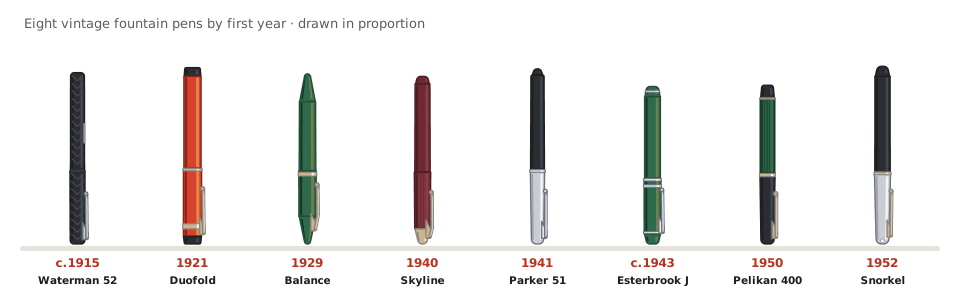
- Parker 51 (Parker, 1941–1972). Made for 31 years, with about 20 million sold per collector sources, and Nishimura calls it the pen “still commonly singled out as the best of all time”. Its hooded nib and Lucite body were built for everyday writing.
- Parker Vacumatic (Parker, 1933–1948 in the US). A plunger-operated rubber diaphragm fills the barrel itself, which Binder says gives a very large ink capacity, behind striped, see-through celluloid.
- Parker Duofold (Parker, 1921). The red “Big Red” Senior is about 14 cm (5.5 in) long, and it launched at US$7.00, a dollar more than the Jack-Knife Safety it grew from, per Binder.
- Sheaffer Balance (Sheaffer, 1929–1942). Binder credits it with making the streamlined torpedo shape mainstream; it came as a lever filler or, from 1935, a Vacuum-Fil plunger filler.
- Sheaffer Snorkel (Sheaffer, 1952–1959). A tube extends past the nib so you fill without dipping it; Binder calls it the most complex filling system ever applied to a fountain pen, yet very reliable.
- Esterbrook J (Esterbrook, about 1943). Its screw-in Renew-Point nibs came in 33 styles, and a restored J was listed for US$95, among the cheapest pens in the catalogs we read.
- Pelikan 400 and 400NN (Pelikan, 1950–1965). A 126 mm (5.0 in) piston filler holding 2.0 ml with a 14 ct gold nib, per pelikan-collectibles.com.
- Waterman’s Ideal No. 52 (Waterman, about 1917). A hard rubber lever filler with a No. 2 nib; Nishimura names Waterman among the best bets for a flexible vintage nib.
- Eversharp Skyline (Wahl-Eversharp, 1940–about 1948). A Henry Dreyfuss design with Eversharp’s renowned nibs; restored Demis were listed at US$225–285.
How do the nine compare?
All nine use a sac, diaphragm or piston that wears out, so the first question is always whether the filler has been serviced. Price examples are asking prices for single restored pens at vintagepens.com, or Peyton Street Pens for the Pelikan, on October 21, 2026; they aren’t market averages.
| Pen | Years | Filling system | Watch for | Price example (asking) | Band |
|---|---|---|---|---|---|
| Parker 51 | 1941–1972 | Vacumatic, then Aero-metric | Vacumatic-filler diaphragm; stained Aero-metric sac | US$150 (1951 Special) to US$785 (1941) | $$$$ |
| Parker Vacumatic | 1933–1948 | Diaphragm pump | Diaphragm; darkened barrel | US$165 (1938 Debutante) to US$475 (1935) | $$$$ |
| Parker Duofold | 1921–1948 | Button filler | Faded hard rubber; cap-lip cracks | US$225 (c. 1926 Junior) to US$1,400 (c. 1922 red Senior) | $$$$ |
| Sheaffer Balance | 1929–1942 | Lever or Vacuum-Fil | Shrinkage, discolored celluloid | US$95 (c. 1933, hairline) | $$$$ |
| Sheaffer Snorkel | 1952–1959 | Snorkel (sac) | Sac, O-ring and point seal | US$150 to US$250 | $$$$ |
| Esterbrook J | c. 1943 | Lever (sac) | Sac; dulled solid colors | US$95 (c. 1946 J) | $$$$ |
| Pelikan 400 / 400NN | 1950–1965 | Piston | Piston seal; brassing | US$300 (1952 400, Peyton Street) | $$$$ |
| Waterman 52 | c. 1917–1930s | Lever (sac) | Light-faded hard rubber | US$225 (c. 1930) | $$$$ |
| Eversharp Skyline | 1940–c. 1948 | Lever with breather tube | Shrunk polystyrene, crumbling inner cap | US$225 to US$285 | $$$$ |
How do you buy a vintage fountain pen safely?
Buy a pen that has been professionally restored and comes with a filling-system guarantee, or price in the cost of restoring one bought as-is. Nishimura’s advice is to ask whether a pen is simply “working” or fully reconditioned, because a pen that writes today can still have a decaying sac.
Peyton Street Pens, for example, gives a one-year filling-system warranty and a 30-day return on pens it restores. For an as-is pen, Nishimura’s FAQ puts a basic repair of an undamaged pen at about US$25–60.
What does “restored” mean for a vintage pen?
A restored pen has new perishable parts, a cleaned feed and a checked nib, not just a polish. Nishimura lists what decays: rubber sacs harden or go porous, cork and rubber seals stop sealing, dried ink clogs the feed, and nibs get bent or worn.
Lever and button fillers get a new sac, Vacumatics a diaphragm, Snorkels a sac, O-ring and point seal, and piston fillers a serviced seal.
How do you check a vintage pen’s condition?
Check the cap lip and barrel mouth for cracks with a magnifier, then the trim, the nib and the straightness of the barrel. Nishimura warns against the old trick of running a fingernail inside the cap, which can start a crack.
Also look for brassed trim, heat shrinkage and nib hairlines. There’s no standard grading scale, so “excellent” varies by seller.
Are vintage nibs flexible?
Some are, but most of these nine have firm nibs as standard. Nishimura says the best flexible nibs come from US pens of the 1920s and earlier, naming Waterman, Wahl and Conklin crescent fillers, while American Duofolds, Vacumatics and post-1920 Sheaffers only rarely have them.
Heavy pressure can spring a flexible nib for good, so heavy-handed writers should choose a firm one.
Can you use modern ink in a vintage fountain pen?
Yes, but choose conservatively, especially in celluloid pens that hold ink against the barrel. Nishimura suggests inks from pen makers such as Waterman, Parker, Sheaffer and Pelikan, and warns that alkaline inks, including many Japanese ones, attack celluloid and latex sacs.
The Parker 51’s Lucite is very resistant to ink damage. Never fill one with the original Parker “51” or Superchrome ink; see our best fountain pen inks for safer everyday choices.
Where should you buy a vintage fountain pen?
From an established restorer or at a pen show, where you can inspect the pen and talk to the person who fixed it. Pen Collectors of America keeps a pen show calendar and a list of repair experts, and Nishimura calls a show the best education in collecting.
eBay can be cheaper but riskier: many pens are unserviced, and Nishimura says “enhanced” and mismatched pens are a bigger worry than fakes.
Is the new Parker 51 the same as the vintage one?
No: the Parker 51 Parker reissued in 2021 is a cartridge/converter pen with a screw cap and an open-style feed, per Richard Binder. It keeps the shape, not the hooded collector system or slip cap. Our best pens of all time covers it.
Which vintage pens almost made the list?
Vintage Montblanc 146 and 149 pens, Conklin crescent fillers and prewar Pilot and Namiki pens came closest. We couldn’t find restorer catalog prices or reference profiles for them as strong as for the nine above.
If you want a new pen first, start with our best fountain pens for beginners. For rarities, see collectible pens, discontinued pens and the most expensive fountain pens.
Frequently asked questions
What is the best vintage fountain pen for a beginner?
A restored Parker 51 or Esterbrook J. The 51's Lucite body resists ink damage and its hooded nib is tough, while the J is the cheapest pick here and takes screw-in Renew-Point nibs in 33 styles.
Is it safe to buy a vintage fountain pen on eBay?
It's riskier than buying from a restorer. Vintage pens have no standard grading scale, "working" doesn't mean the sac and seals were replaced, and returns depend on the seller. Budget for a restoration, or buy from a seller who guarantees the filling system.
How much does it cost to restore a vintage fountain pen?
David Nishimura's FAQ puts a basic restoration of an undamaged pen with no missing parts at about US$25–60, depending on the filling mechanism. Cracks, missing parts or nib repairs cost more.
Do vintage fountain pens need a new ink sac?
Usually, if the pen hasn't been serviced. After decades, rubber sacs harden or go porous and cork and rubber seals stop sealing, so lever, button, Snorkel and Vacumatic pens normally need new sacs, seals or diaphragms.
Can I use Parker 51 ink in a vintage Parker 51?
No. The original Parker "51" ink, later sold as Superchrome, contained lye (sodium hydroxide), per Richard Binder, and Nishimura calls surviving bottles display items. Use an ordinary modern fountain pen ink from a pen maker instead.
Are vintage fountain pens a good investment?
We wouldn't buy them as one. Prices depend on rarity, color and condition, and Nishimura notes that a mustard Parker 51 costs a few hundred dollars more than an identical black one. Buy a pen you'll use.
How can I tell how old a Parker 51 is?
Look for a date code on the barrel imprint. Parker stamped date codes until the early to mid-1950s, per Richard Binder; later pens can only be narrowed to a range by filler type and clip style.
Sources
- Richard Binder: The Parker "51" (1941–1972, Vacumatic and Aero-metric fillers, 2021 reissue)
- Richard Binder: The Parker Vacumatic (1933–1948, diaphragm filler)
- Richard Binder: The Parker Duofold (1921, US$7.00 price tag, button filler)
- Richard Binder: The Sheaffer Balance (1929–1942, lever and Vacuum-Fil fillers)
- Richard Binder: The Sheaffer Snorkel (1952–1959)
- Richard Binder: The Esterbrook J series
- Richard Binder: Esterbrook Renew-Point nibs (33 styles)
- Richard Binder: The Waterman's Ideal No. 52
- Richard Binder: The Eversharp Skyline (1940–about 1948, polystyrene shrinkage)
- Pelikan-collectibles.com: Pelikan 400 (1950–1956, 126 mm, 15.3 g, 2.0 ml)
- Pelikan-collectibles.com: Pelikan 400NN (1956–1965, 130 mm)
- David Nishimura, vintagepens.com: Getting started with vintage pens
- vintagepens.com FAQ: Why do pens need to be reconditioned?
- vintagepens.com FAQ: Can my old pen be fixed? (US$25–60 typical)
- vintagepens.com FAQ: What are flexible nibs all about?
- vintagepens.com FAQ: What kind of ink should I use?
- vintagepens.com FAQ: Vintage pen pricing
- vintagepens.com FAQ: Inspecting and evaluating vintage pens
- vintagepens.com FAQ: Describing vintage pens (no standard grading scale)
- vintagepens.com FAQ: Fakes and forgeries
- vintagepens.com FAQ: Pen show basics
- vintagepens.com FAQ: Sheaffer Snorkel and PFM repair (O-ring and point seal)
- vintagepens.com FAQ: Discoloration and its causes (hard rubber fading)
- vintagepens.com catalog: Parker 51 (asking prices, read October 21, 2026)
- vintagepens.com catalog: Parker Vacumatics
- vintagepens.com catalog: Parker Duofolds
- vintagepens.com catalog: Sheaffer streamline pens (Balance)
- vintagepens.com catalog: Sheaffer Touchdown, Snorkel and PFM
- vintagepens.com catalog: Esterbrook
- vintagepens.com catalog: Waterman (lever fillers)
- vintagepens.com catalog: Eversharp Skylines
- Peyton Street Pens: Pelikan 400, 1952 (reference listing, US$300, out of stock)
- Peyton Street Pens: Vintage restored writing instruments (one-year filling-system warranty)
- Pen Collectors of America: Pen show calendar
- Pen Collectors of America: Pen repair experts
- Parkerpens.net: Parker 51 (over 20 million sold)
- Parker: A 20th century classic reimagined (Parker 51, 2021)